

Introducing IonSight: The measurement engine behind the future of drug discovery
Drug discovery runs on data. Yet for decades, much of that data has been indirect, noisy, and at the earliest stages surprisingly unreliable. It’s one of the reasons developing a new medicine still costs billions and takes more than a decade.
IonSight, a spinout from the University of Oxford, is building something different: a new measurement layer for drug discovery. By unlocking the power of native mass spectrometry with machine learning, the venture aims to give scientists a direct, high-fidelity view of how drugs interact with proteins, turning one of pharma’s biggest bottlenecks into a platform for faster, smarter, and more successful discovery.
At Zinc, this is exactly the kind of Science-for-Impact venture we look to back: scalable deep-tech infrastructure with the potential to reshape how an entire industry works.
The problem: drug discovery is still built on inference
Early-stage drug discovery begins with a simple question: does this molecule bind to the target protein?
Most existing screening methods don’t actually observe binding directly. Instead, they rely on proxy signals, such as fluorescence, surface interactions, or biochemical reactions, to infer what might be happening at the molecular level. These approaches can produce both false positives (weak candidates that look promising) and false negatives (strong candidates that get discarded).
Those early errors then compound downstream. A weak candidate can cost hundreds of millions before failure becomes obvious. A discarded candidate might have been the next breakthrough therapy.
IonSight’s founders believe this isn’t a chemistry problem. It’s a measurement problem.
As CEO Rod Chalk puts it, the company is ultimately selling one thing – trust – data that drug developers can rely on from the very start.
What IonSight is building
IonSight is developing a platform that uses native mass spectrometry (nMS) to directly observe drug-protein binding in solution. Unlike conventional approaches, this technique preserves molecular complexes intact, allowing researchers to see not just whether binding occurs, but how it happens.
Native mass spectrometry has long been known among specialists as an extraordinarily powerful tool. The challenge is that it produces extremely complex datasets that typically require expert interpretation that doesn’t scale.
This is where IonSight’s core innovation comes in.
The company’s technology stack centers on its machine-learning software that automatically analyses these spectra, transforming what has historically been a complex, manual, niche process into something scalable and accessible. Their goal is a high-throughput, end-to-end platform that can characterise thousands of complex protein interactions in seconds, matching or exceeding expert performance.
In other words, IonSight isn’t inventing a new instrument. It’s unlocking the full potential of an existing scientific method through computation. This is why we think of IonSight as a drug discovery infrastructure company. And potentially the measurement standard layer of the drug discovery stack.
Why now? AI needs better data
There’s a prevailing narrative that drug discovery will soon happen entirely in silico. With advances in AI-driven molecular design, some assume lab-based experiments will become less important. The IonSight team sees beyond this.
As co-founder and CTO Mark van der Wilk explains, machine learning systems are fundamentally limited by the quality of their training data. Models cannot outperform the measurements they learn from. If AI is to design better drugs, it will need richer, more reliable experimental datasets, not fewer.
Native mass spectrometry produces exactly that: dense, information-rich measurements that capture molecular interactions directly. IonSight’s platform is designed to make those measurements scalable enough to feed the next generation of drug-design algorithms. In that sense, IonSight is enabling AI drug discovery, rather than competing with it.
Meet the team: rare alignment of complementary expertise
The most impactful platform innovations come from inter-disciplinary breakthroughs. IonSight is being built where mass spectrometry, protein science and machine learning intersect:
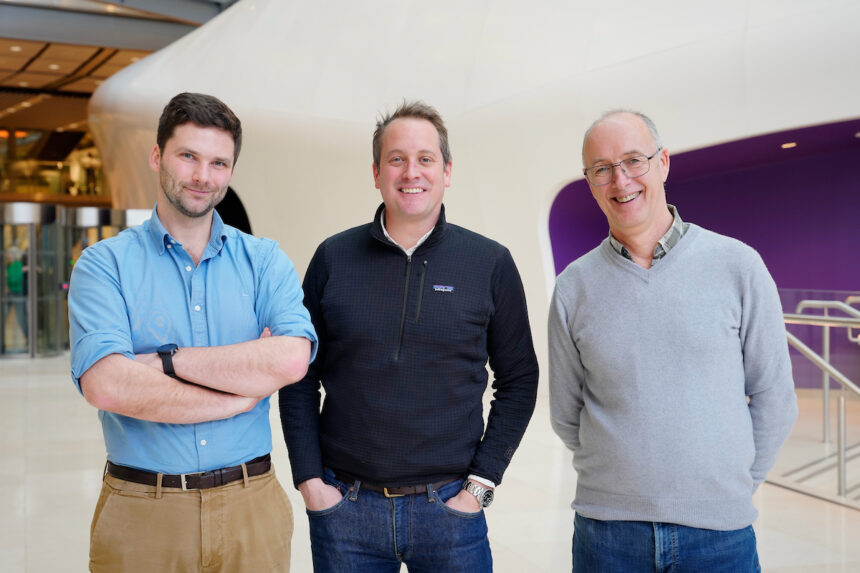
- Rod Chalk, CEO, brings nearly three decades of experience in mass spectrometry and a career spent working across research domains.
- Weston Struwe, CSO, is a leading academic expert in protein science, glycobiology and native MS applications.
- Mark van der Wilk, CTO, is an Oxford machine learning professor known for work on data-efficient AI methods.
Their venture emerged organically from their collaboration. Rod and Weston began by fielding repeated requests for specialist analyses from researchers and industry partners. It became clear there was significant demand – but also that manual analysis would never scale. The missing piece was automation. It was only when, within Oxford’s active innovation ecosystem, Rod was connected with Mark, that the platform vision and commercial opportunity clicked into place.
Few teams combine this deep experimental domain expertise, cutting-edge machine learning research and firsthand exposure to real customer demand. This combination is hard to replicate, and difficult to compete with.
Early progress
The team has moved quickly from concept to capability. The science is already proven: the team can run native mass spectrometry screens today using existing instruments. The constraint isn’t whether the method works, it is scale. And that’s exactly the problem their software is built to solve.
With Zinc’s backing, IonSight is now focused on building its first production-ready machine-learning system to automate analysis and unlock high-throughput screening. Early conversations with CROs and biotech partners are underway, with pilot projects planned to benchmark performance against current industry standards.
Because the hardware already exists, capital is being deployed where it creates the most leverage: the AI layer. The goal over the next 12 months is clear: to demonstrate automated, high-fidelity screening in live commercial settings and prove that better measurement can drive better drug discovery decisions.
The scale of the opportunity
IonSight is targeting an existing global market worth tens of billions of pounds across screening, binding analysis, and protein characterisation. But the bigger vision isn’t just replacing existing methods, it is setting an entirely new industry standard in measurement.
IonSight is on track to enable drug developers to move from indirect guesses to direct observation at the earliest stages of research. That will mean:
- Fewer failed clinical programs
- Faster development timelines
- Lower R&D costs
- More viable drugs reaching patients
The potential health impact is enormous. Even a modest increase in early-stage screening accuracy could translate into thousands of additional successful therapies making it to patients over time.
And if native mass spectrometry becomes routine (as proteomics did two decades ago) it could shift from niche technique to industry standard. The team’s long-term goal is to make their platform a default layer in drug discovery workflows within the next decade.
The Science-for-Impact journey to success
IonSight’s next phase is focused on turning proven science into a scalable, productised platform. The immediate priority is building its first production-ready software platform, enabling automated analysis and high-throughput screening. Early pilot projects with partners will validate performance against existing methods, generate real-world datasets, and help refine the system.
From there, the company can scale in multiple ways – licensing its software to partners or offering end-to-end screening services. While drug discovery is the initial focus, the longer-term vision is broader: to become a trusted measurement layer for molecular interaction analysis across the life sciences.
Why Zinc is excited to partner with IonSight
Here at Zinc, we invest in founders using science and technology to drive meaningful impact and commercial returns. IonSight embodies that approach by building infrastructure that could improve how all drugs are discovered, increasing the quality of early-stage data and strengthening decisions across the pipeline.
This is Science-for-Impact in action: applying advanced machine learning to unlock a powerful but underutilised scientific method, and turning specialist capability into scalable infrastructure. We’re excited to partner with this team combining deep scientific expertise with commercial focus – and to support them as they work to make better measurement the foundation of better medicine.
Join the Zinc community
Stay up to date with all Zinc updates and future posts as part of our fast growing community.
Featured Resources
Zinc Impact Report 2025
Science has the power to change the world – but only if the systems around it evolve. Zinc’s 2025 Science-for-Impact Report showcases a new model for how science, talent and capital can work together to tackle the most urgent challenges in health and the environment.
Across 38 pioneering Science-for-Impact ventures, a series of ecosystem-shaping partnerships and programmes, and a growing global community of talented innovators, the report demonstrates how frontier research is being transformed into scalable solutions for people and planet.
Through Zinc’s three pillars – Investment, Innovation Partnerships, and Inflection – Zinc is building the connective tissue of a new Science-for-Impact system. Explore the ventures, meet the founders, and see how you can join us in unlocking the extraordinary individuals who will unlock the future.
Zinc Impact Report 2024
Zinc’s mission is to make the UK the best place to successfully start a venture which can have a massive impact on the health of people and the planet.
Increasingly, we are building deeper science ventures that serve global, industrial customers in environment and health, giving access to impact at a global scale.
Our 2024 Impact Report explores the challenges that need to be tackled to empower and enable talented founders from around the world to solve critical health and environmental challenges at scale, from here in the UK.
This report showcases success stories from the Zinc portfolio, and highlights how Zinc – and our growing community of hundreds of Founders, Fellows, Coaches, Partners and Funders – are working together to build a world-leading “Science-for-Impact” ecosystem for inception stage ventures in health and environment.