

Announcing Zinc’s investment in KiloGen: Building the future of molecular glue drug discovery
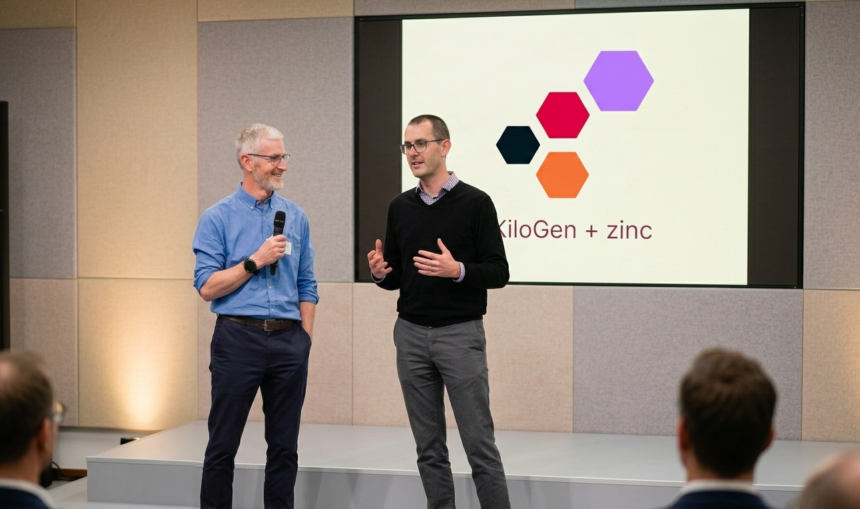
At Zinc, we back founders building category-creating companies that can transform outcomes in health and beyond. We’re excited to announce our investment in KiloGen, a Cambridge-based biotech developing a new platform for rational molecular glue discovery – unlocking one of the most promising and least solved frontiers in modern drug development.
Led by experienced drug discovery leaders Mark McAlister PhD and Michał Biśta PhD, KiloGen is tackling a problem that has constrained medicine for decades: the vast majority of disease-driving proteins remain beyond the reach of conventional drugs.
Their ambition is to make molecular glue discovery systematic, scalable, and repeatable. And in doing so, open up a new era of programmable pharmacology.
Unlocking the “undruggable” majority
Despite extraordinary progress in modern medicine, today’s small-molecule drugs can only target a fraction of human biology.
Most medicines work by binding to a defined pocket on a protein and inhibiting its activity. But only a small minority of proteins have the right structure to make that possible. As a result, the overwhelming majority of proteins implicated in disease are considered “undruggable”.
This is where molecular glues come in
Rather than simply blocking a protein, molecular glues bring two proteins together, creating new interactions that can switch disease pathways on or off, alter cell behaviour, or trigger degradation of harmful proteins altogether.
The concept is already clinically validated. Some of the world’s most successful cancer drugs, including multi-billion-dollar therapies, work through molecular glue mechanisms. But almost all were discovered by accident.
That is the bottleneck KiloGen exists to solve.
As CEO Mark McAlister puts it: “Molecular glues are incredibly powerful, but until now they’ve largely been found by fluke. We believe they can be built systematically.”
Creating molecular glues
KiloGen is building an integrated discovery engine designed specifically for molecular glues combining computational prediction, structural biology insight, and proprietary experimental assays for screening and validation.
AI enabled computational workflows are designed to identify promising protein-pair interactions and chemical starting points earlier and more systematically than traditional discovery approaches, narrowing the search space for wet-lab work. Proprietary experimental workflows then support the identification, validation, and prioritisation of promising molecular glue interactions.
KiloGen aims to improve the efficiency of molecular glue discovery and create a repeatable path from target hypothesis to validated lead molecule. With this approach, the team aims to move molecular glue discovery beyond serendipity and toward a more scalable discovery model.
Built by experts who have lived the problem
KiloGen’s founders bring decades of directly relevant experience from the front lines of pharmaceutical R&D.
Mark McAlister, PhD (CEO), spent more than 20 years in drug discovery at AstraZeneca, where he served as Director of Biophysics, contributing to over 130 early drug discovery projects and several candidate drugs. Previously he was scientific co-founder of Domainex, now a leading Cambridge structure-based drug discovery CRO.
Michał Biśta, PhD (CSO), is a former VP at targeted protein degradation company Captor Therapeutics and previously held senior scientific roles at AstraZeneca, where he contributed to multiple clinical-stage drug programmes.
The pair first worked together nearly a decade ago and reunited around a shared conviction that molecular glue discovery could be transformed through a fundamentally new approach.
They have assembled an exceptional advisory network around them, spanning medicinal chemistry, bioinformatics, oncology biology, and pharma business development, giving KiloGen the strategic and scientific depth required to execute in this highly complex space:
Professor Mike Waring, Chair of Medicinal Chemistry at Newcastle University and one of the UK’s leading medicinal chemists, whose track record includes fourteen drug candidates and the discovery work behind AstraZeneca’s blockbuster EGFR inhibitor osimertinib (Tagrisso™).
Dr Marcin Cieślik, Assistant Professor at the University of Michigan, who brings deep expertise in computational biology, cancer genomics, and algorithm development, helping bridge computational prediction with experimental and translational science.
Dr Iain Comley, Director of BeaDy Solutions and former head of transactions at Astrazeneca, who brings over 25 years of business development experience from biotech and big pharma and expertise in business development, partnerships and licensing.
An inflection point for molecular glues
That are several factors that make this the right moment for KiloGen:
- The biology is validated: Molecular glues are no longer theoretical, they are proven to work both clinically and commercially.
- The technology has matured: Advances in AI, structural biology, and computational protein modelling now make rational design feasible in ways that were impossible even five years ago.
- Pharma demand is rising: Large pharmaceutical companies are actively searching for next-generation modalities that expand beyond conventional inhibition and targeted degradation.
KiloGen is innovating at the intersection of these three trends.
A platform with both revenue and drug asset potential
KiloGen is pursuing a hybrid platform-plus-pipeline model. In the near term, the company plans to partner with pharmaceutical companies seeking help on difficult drug targets – using its platform to discover molecular glues for external programmes. Longer term, the team sees an even bigger opportunity in building their own internal pipeline of novel therapeutics.
The company’s first programmes focus on oncology, where molecular glues could unlock entirely new mechanisms for treating cancers with high unmet need, including patients who have developed resistance to existing therapies.
This dual strategy offers nearer-term commercial validation and partnership revenue and long-term asymmetric upside through proprietary drug assets.
KiloGen has already made significant technical progress:
- Built and validated the initial version of its AI-enabled target and glue prediction workflows
- Established proof of concept for proprietary hit to lead assay cascades
- Identified internal oncology programmes, target-effector hypotheses and library chemistry
- Secured early strategic interest from pharmaceutical partners
This funding from Zinc will now enable the team to accelerate their work to:
- Extend platform validation across additional molecular glue systems
- Screen internal programmes for novel glue hits
- Identify novel cell-active molecular glue leads
- Deepen strategic pharma engagement and partnership discussions
These milestones will meaningfully de-risk both the platform and the underlying therapeutic thesis.
Why Zinc is backing KiloGen
At Zinc, we invest in world-class founders building transformative companies at the intersection of science, technology, and impact. The KiloGen team is tackling one of the hardest and most consequential challenges in therapeutics with a combination of:
- Deep technical and domain expertise
- Novel defensible IP
- A potentially category-defining platform
- A credible path to both health impact and venture-scale returns
We believe KiloGen has the potential to create an entirely new standard for how medicines are discovered. Their platform has the potential to unlock previously inaccessible biology, enabling new treatments for patients with limited options, and become foundational infrastructure for the next generation of drug discovery.
We’re excited to partner with Mark, Michał, and the KiloGen team at this early stage – and proud to support them as they build what could become one of Europe’s most important next-generation biotech platforms.
Join the Zinc community
Stay up to date with all Zinc updates and future posts as part of our fast growing community.
Featured Resources
Zinc Impact Report 2025
Science has the power to change the world – but only if the systems around it evolve. Zinc’s 2025 Science-for-Impact Report showcases a new model for how science, talent and capital can work together to tackle the most urgent challenges in health and the environment.
Across 38 pioneering Science-for-Impact ventures, a series of ecosystem-shaping partnerships and programmes, and a growing global community of talented innovators, the report demonstrates how frontier research is being transformed into scalable solutions for people and planet.
Through Zinc’s three pillars – Investment, Innovation Partnerships, and Inflection – Zinc is building the connective tissue of a new Science-for-Impact system. Explore the ventures, meet the founders, and see how you can join us in unlocking the extraordinary individuals who will unlock the future.
Zinc Impact Report 2024
Zinc’s mission is to make the UK the best place to successfully start a venture which can have a massive impact on the health of people and the planet.
Increasingly, we are building deeper science ventures that serve global, industrial customers in environment and health, giving access to impact at a global scale.
Our 2024 Impact Report explores the challenges that need to be tackled to empower and enable talented founders from around the world to solve critical health and environmental challenges at scale, from here in the UK.
This report showcases success stories from the Zinc portfolio, and highlights how Zinc – and our growing community of hundreds of Founders, Fellows, Coaches, Partners and Funders – are working together to build a world-leading “Science-for-Impact” ecosystem for inception stage ventures in health and environment.