

Investing in Neurolase to bring precision, AI and real-time molecular insight into brain surgery
There are investments that are anchored in technological advancements, and those that are also deeply personal. Our recent investment in Neurolase is both.
Two foundational members of the Zinc team were diagnosed with glioblastoma at the age of 27. Neurolase co-founder Monika Kott has also experienced the devastating reality of brain cancer firsthand when her cousin was diagnosed with glioblastoma, an experience that would ultimately become central to the creation of the company.
These experiences reinforced something we had already come to believe: that brain tumour surgery remains one of the most important and most underserved areas in medical technology, and that the right innovation, in the right hands, can meaningfully change outcomes for patients. It is this conviction that drives Zinc’s determination to put capital to work where it can make a difference.
A devastating disease hiding in plain sight
Brain cancer carries a disproportionate burden relative to its incidence. It is the leading cause of cancer-related death in people under 40, causes more years of life lost than any other cancer, and carries a median survival of approximately 15 months. Around 300,000 people are diagnosed globally each year – a figure projected to rise by nearly 50% by 2045. 90% of patients undergo surgery as their first line of treatment.
The fundamental challenge of that surgery has remained largely unsolved for decades. Brain tumour tissue is visually and texturally indistinguishable from healthy brain tissue at the margins. Surgeons must navigate by experience and judgment, often in prolonged and cognitively demanding procedures.
The clinical evidence is clear: more complete tumour resection correlates directly with improved survival and quality of life. But in the absence of reliable intraoperative guidance, surgeons must balance the imperative to remove tumour tissue against the risk of damaging the healthy tissue that governs speech, movement, and cognitive function. In that uncertainty, tumour is frequently left behind.
This isn’t a failure of surgical skill, it is a failure of the tools currently available.
The Neurolase System
Neurolase has developed a handheld intraoperative guidance system that uses Raman spectroscopy and artificial intelligence to distinguish tumour tissue from healthy brain tissue in real time, during surgery, without contact with or damage to the brain.
A probe is introduced into the surgical cavity. Laser light interacts with the molecular structure of the tissue it encounters, generating a spectral signature that is chemically unique to that tissue type. A machine learning model processes this data instantaneously and classifies the tissue – tumour or healthy, and tumour grade – alerting the surgeon via both visual and auditory output. The system requires no specialist training beyond normal surgical competence, integrates directly into existing operative workflow, and imposes no additional burden on the patient.
Against the current landscape of intraoperative technologies (including MRI and ultrasound imaging, fluorescence-guided surgery, frozen section histology, and emerging confocal and hyperspectral imaging platforms) Neurolase is the only system that combines real-time guidance, point analysis, and full surgical workflow integration.
It is also, critically, the simplest to use: fluorescence-guided surgery requires a specialist course and 24 hours of patient photosensitivity management; intraoperative MRI requires whole-team safety certification; pathology-based approaches require fully trained laboratory staff. Neurolase requires none of these, which matters enormously when it comes to clinical adoption.
Why now?
Neurolase technology has been developed to capitalise on convergence of key enabling conditions over the last few years:
The first is computational capacity. Raman spectroscopy generates highly complex, multi-dimensional data. Real-time classification of that data during surgery was not practically achievable until machine learning infrastructure reached sufficient maturity and speed. The ability to process large volumes of spectral information within milliseconds and return a clinically meaningful output is a recent capability, and it is foundational to the Neurolase product.
The second is scientific understanding. Brain tumours are, molecularly speaking, a recently characterised disease. The genomic and pathway-level knowledge that now underpins precision oncology in this space has accumulated largely within the last decade. Any technology that can capture molecular tissue information from a living tumour – in situ and in real time – becomes significantly more valuable in an era of precision medicine than it would have been in previous generations. Neurolase is well-positioned to contribute to both surgical outcomes and the broader molecular characterisation of individual tumours.
The third is advocacy and policy momentum. The Brain Tumour Charity, Brain Tumour Research, and the Tessa Jowell Foundation have driven sustained and increasingly effective campaigns for improved funding and NHS adoption in this area. There is now an All-Party Parliamentary Group for brain tumours. For the first time, there is meaningful political will, alongside clinical appetite, to accelerate the adoption of technologies that can improve survival in this patient population.
Meet the founding team
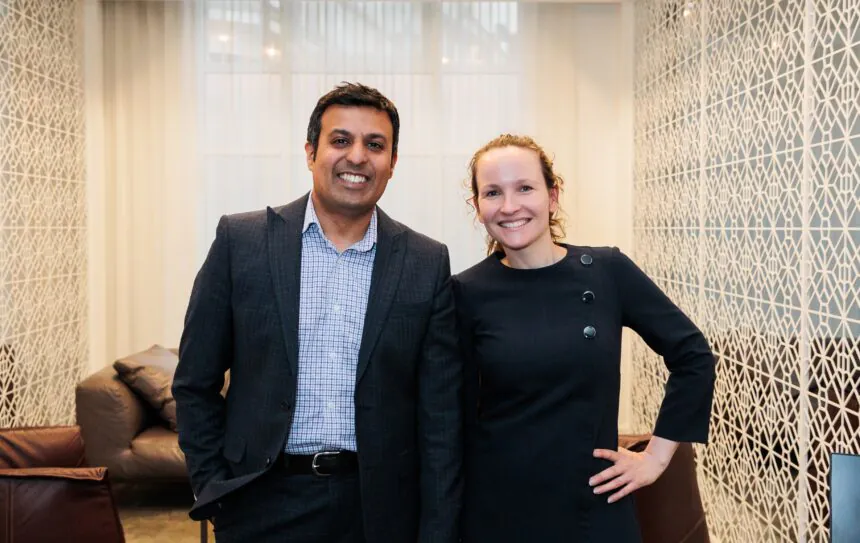
Neurolase was co-founded by Babar Vaqas, FRCS PhD, a consultant neurosurgeon and the inventor of the system, and Monika Kott, CEO, who brings over a decade of experience in health technology across M&A, strategy, and venture-backed operations.
Babar developed the Neurolase technology during his PhD at Imperial College London, undertaking the research while simultaneously completing his surgical training. The result was the combination of both the scientific rigour of an academic programme and the clinical instincts of a practising surgeon. He identified the problem from within the operating room, designed a solution grounded in real surgical workflow, and ran the first clinical trials himself. He has since become a consultant neurosurgeon, leading his own team, while continuing to develop Neurolase. His background spans Imperial, Cambridge, Oxford, UCL, and the NHS.
Monika’s path to Neurolase is both professionally compelling and personally significant. With a background in healthcare M&A at Rothschild, a master’s in Healthcare Management from Imperial, and a senior role at Alchemab Therapeutics, she brings commercial depth and operational experience. She and Babar had built a professional relationship over several years before co-founding the company, but it was her cousin’s glioblastoma diagnosis in 2021 that crystallised the decision to bring Neurolase to market.
Monika’s cousin’s experience highlights exactly the gap Neurolase addresses. Her initial surgery in Poland removed only the enhancing, MRI-visible portion of the tumour, leaving behind the non-enhancing infiltrative margins that remain invisible to conventional intraoperative guidance. This is not an unusual outcome; it reflects the limitations of current technology rather than any failure of the surgical team. Following the recurrence, Monika arranged a second surgery in the UK, with Babar and colleagues deploying every available technique: intraoperative MRI, brain mapping and fluorescence.
Her cousin is now five years post-diagnosis, a meaningful milestone for a disease where median survival is measured in months. This journey also gave Monika an unusually nuanced understanding of the patient journey: not just the clinical outcomes, but the practical and psychological toll that existing technologies can impose. Fluorescence-guided surgery, for example, requires patients to be fully light-protected for 24 hours prior to the procedure, an experience she describes as profoundly distressing on top of an already frightening surgical pathway.
This patient-centred perspective has directly influenced how Neurolase has been built: a system that is not only more effective, but meaningfully easier on everyone in the room. It is also a perspective that speaks to the broader dynamic between the two founders. Babar brings the scientific rigour, clinical credibility, and deep domain knowledge that gives the technology its foundation; Monika brings the commercial instinct, strategic clarity, and operational experience to turn it into a company.
Validation and clinical progress
Neurolase has now completed a 30-patient pilot study, collecting over 1,000 spectra from patients during live surgery. The system achieved greater than 94% sensitivity and specificity in detecting cancerous tissue – compared to highly variable subjective margin identification by the surgeon.
The technology has demonstrated something beyond raw performance: it works in a real surgical environment. It has been used during actual operations, tested against the complexity and constraints of live procedures, and validated by the surgeons who would need to adopt it. Key Opinion Leaders at Great Ormond Street Hospital, King’s College London, Imperial College London, Leeds Teaching Hospitals, and Tufts University in Boston have reviewed or trialled the system. Their response has been unambiguous: this addresses a genuine unmet need.
“The single most attractive feature is the molecular information during the surgery which we can incorporate in decisions about surgical aggressiveness. This is something that is not provided by any other adjunct at the moment.”
— Mr Jose Pedro Lavrador, Consultant Neurosurgeon, King’s College London,
Market and commercial opportunity
The global brain tumour diagnostics and therapeutics market is valued at £1.8 billion today and projected to reach £2.7 billion by 2030, growing at a CAGR of 8.5%, driven by rising incidence, improved detection, and an accelerating shift towards precision surgical approaches.
Neurolase’s commercial strategy is designed for multiple, compounding revenue streams: direct hardware sales, probe consumables, subscription access to data models, diagnostics services, data monetisation, and licensing and partnership arrangements. The addressable market extends beyond the surgical market itself, into personalised medicine and the broader diagnostics space, as the molecular information captured by the system becomes increasingly valuable for treatment planning.
Their target early adopter network spans hundreds of neurosurgical centres in the UK, US and Europe. The company’s longer-term ambition extends beyond brain tumours to other cancers requiring precise margin delineation. Prostate and breast cancer are identified as near-term targets, with the vision of establishing Neurolase as a platform for precision intraoperative guidance across multiple indications.
The journey to success
Over the next 12 to 18 months, the priorities are team expansion, completion of the usability study, and securing regulatory approval for the validation programme.
Their regulatory pathway targets MHRA filing in 2027, a three-site validation study beginning in 2028, a 400-patient pivotal trial from 2029, and CE mark and FDA filings in 2031, with FDA breakthrough designation engagement already underway.
Why Zinc backed Neurolase
Zinc partners with founders who combine exceptional domain expertise with the commercial conviction to translate it into impact at scale. In Babar and Monika, we see both: a clinical inventor with deep scientific credibility and direct knowledge of the problem, paired with a commercially experienced operator who brings urgency, strategic instinct, and a patient’s perspective to everything the company builds.
The technology is validated, the IP is protected, the clinical community is engaged, and the market conditions are favourable. The regulatory path is clear. The founding team is, in our view, precisely the right combination of people to execute it.
This investment also carries personal weight for us. Brain tumours devastate lives with a speed and brutality that other cancers rarely match. They take people who are young, in the middle of careers and families and futures. We have seen that at first hand within our own team.
By improving the quality and completeness of the first surgery, we believe Neurolase has the potential to give patients more time, better outcomes, and a fighting chance at the life they were living before diagnosis. That is precisely the kind of impact Zinc exists to accelerate.
Join the Zinc community
Stay up to date with all Zinc updates and future posts as part of our fast growing community.
Featured Resources
Zinc Impact Report 2025
Science has the power to change the world – but only if the systems around it evolve. Zinc’s 2025 Science-for-Impact Report showcases a new model for how science, talent and capital can work together to tackle the most urgent challenges in health and the environment.
Across 38 pioneering Science-for-Impact ventures, a series of ecosystem-shaping partnerships and programmes, and a growing global community of talented innovators, the report demonstrates how frontier research is being transformed into scalable solutions for people and planet.
Through Zinc’s three pillars – Investment, Innovation Partnerships, and Inflection – Zinc is building the connective tissue of a new Science-for-Impact system. Explore the ventures, meet the founders, and see how you can join us in unlocking the extraordinary individuals who will unlock the future.
Zinc Impact Report 2024
Zinc’s mission is to make the UK the best place to successfully start a venture which can have a massive impact on the health of people and the planet.
Increasingly, we are building deeper science ventures that serve global, industrial customers in environment and health, giving access to impact at a global scale.
Our 2024 Impact Report explores the challenges that need to be tackled to empower and enable talented founders from around the world to solve critical health and environmental challenges at scale, from here in the UK.
This report showcases success stories from the Zinc portfolio, and highlights how Zinc – and our growing community of hundreds of Founders, Fellows, Coaches, Partners and Funders – are working together to build a world-leading “Science-for-Impact” ecosystem for inception stage ventures in health and environment.