

Meet Rhizo PTX: Rethinking Green Ammonia Production
The world urgently needs green ammonia. It has three main uses: as a decarbonised fertiliser for sustainable agriculture, as a clean-burning fuel for ships and power generation, and as a carrier for energy storage and transport. The demand is massive, urgent, and growing. But the supply isn’t keeping pace.
Tackling this enormous challenge is the latest addition to Zinc’s Science-for-Impact portfolio: Rhizo PTX, an exciting new venture building electrochemical technology to produce green ammonia directly from air and water, bypassing the need for green hydrogen entirely.
The ammonia problem nobody is solving
Ammonia is everywhere in our lives. It is the foundation of global fertiliser production, feeding billions of people. It’s used to make nylon, pharmaceuticals and countless other chemical products. Yet, this critical chemical comes at the cost of consuming 2% of all global energy and producing nearly 2% of all greenhouse gas emissions.
However, ammonia is on the verge rocketing past its current role to become the undisputed fuel of a decarbonised world. As countries race to decarbonise, green ammonia is emerging as a critical energy carrier for hard-to-abate sectors. Japan has already converted power stations to run on ammonia and is building storage capacity that rivals that of Australia, and major shipping companies are commissioning ammonia powered ships, with 144 ships ordered to-date. When you add up all the existing and emerging applications, green ammonia could address up to 40% of anthropogenic greenhouse gases.
The problem? Producing green ammonia at scale
Most green ammonia projects follow the same playbook: build renewable energy assets, add electrolysers to produce green hydrogen, then feed that hydrogen into traditional Haber-Bosch reactors. On paper, it’s simple. In practice, these projects routinely fail at the feasibility stage. The economics don’t work. The intermittency of renewables doesn’t integrate well with Haber-Bosch plants that need constant, high-pressure hydrogen supply. Projects require massive battery or hydrogen storage to level out production, and expensive hydrogen compressors – costs that make the whole enterprise unviable. Many supplement with steam-reformed hydrogen from fossil fuels when the wind doesn’t blow, defeating the purpose entirely.
Enter Rhizo PTX with a totally different approach
Rhizo PTX is taking a fundamentally different path. Their patented Nitrolyzer produces ammonia directly from nitrogen in the air and water, using renewable electrons. No hydrogen production. No hydrogen storage. No Haber-Bosch reactor.
The Nitrolyzer technology uses aqueous electrolytes and a non-platinum group working electrode catalyst made from abundant earth materials, significantly reducing manufacturing costs and supply chain risks. The modular design means production can be scaled and decentralised, sitting wherever curtailed renewable energy exists.
This matters enormously in markets like the UK, where energy curtailment (when renewable energy can’t be used and is essentially wasted) cost the taxpayers and asset owners around £1 billion in 2024. Rhizo PTX’s technology is designed specifically to harness this intermittent energy, turning a grid management problem into a green ammonia opportunity.
The right team at the right time
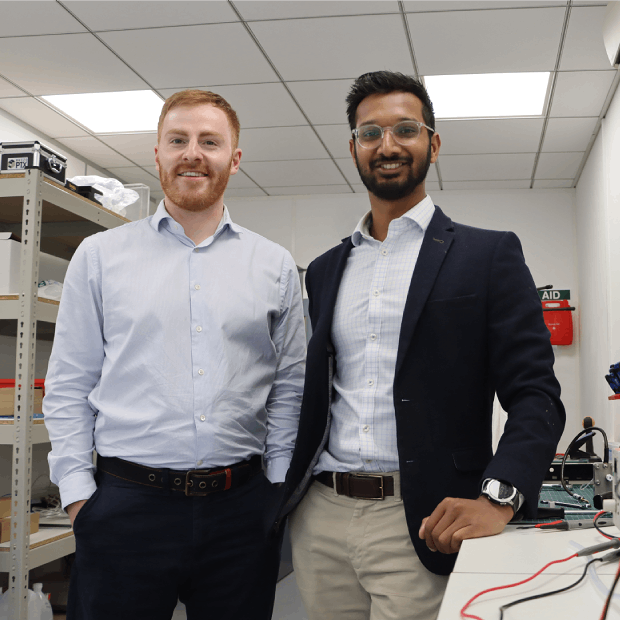
Co-founders Ash Stott, PhD (CEO) and Ben Kyffin, PhD (CTO) aren’t just scientists with an interesting idea, they’re electrochemistry specialists who’ve learned hard lessons about what it takes to industrialise novel technology.
Ash spent his PhD focused on electrochemical degradation, a niche but crucial area for industrialising technology. He worked at Ceres Power as a senior electrochemist leading the cathode degradation team. Here he collaborated closely with Robert Bosch to de-risk the performance of hydrogen fuel-cells. That experience taught him that hydrogen has fewer practical use cases than the hype suggests, and that there had to be a better material for climate impact.
Ben brings complementary skills in making systems and processes work at scale. His background spans large-scale synthesis of liquid crystalline materials, modelling pharmaceutical processes to reduce solvent changeover costs, developing scalable biomaterials, and process development for energy storage devices. At Ceres Power, he focused on scaling up energy materials and applying new electrode materials in commercial environments.
Both are driven by the conviction that real climate impact requires commercial success, not just policy changes. As Ben puts it: “If you want real climate impact, you have to build a commercially viable solution. We are driven by the conviction that commercial success, not just policy, is the only way to win this.”
Their complementary skills – Ash finding what doesn’t work, Ben building what does – and their shared experience industrialising electrochemical technologies at Ceres Power makes them a uniquely positioned founding team to tackle this complex challenge.
Why now?
The global ammonia landscape has transformed in just the past two years. Every week brings announcements of new green ammonia projects, partnerships, and infrastructure. Japan, Australia, and other Asian countries are moving aggressively because they’re industrially minded and practical. They have already determined that ammonia works better than hydrogen for shipping, power generation, and industrial heat.
Europe and the UK are now catching up, driven by the reality of renewable curtailment and the need for practical energy storage solutions. As Ash observed after a recent conference in Australia: “As countries decarbonise their electricity grid with more renewable assets, they’re going to have the same curtailment problems the UK has. This is a huge opportunity we can leverage to get cheap clean energy for our technology”.
The window for investment in innovation is now. Green ammonia demand is exploding, but current production methods aren’t delivering. Rhizo PTX has lab-scale systems (TRL 4) and a clear path to commercial-scale pilots (TRL 5-6) within three years.
A huge commercial opportunity
Rhizo PTX is pursuing a collaborative owner-operator model, avoiding the historical pitfalls of equipment sales and IP licensing. By partnering with a major engineering service provider, the company will rapidly scale manufacturing to produce and sell ammonia directly through established global channels.
This strategy mitigates the risk of licensing unproven processes for ‘first-of-a-kind’ plants. Instead, Rhizo PTX will co-develop critical manufacturing expertise alongside its partners.
The company sits at the intersection of multiple massive markets:
- Fertiliser production: The existing 2% of global energy consumption
- Chemical feedstocks: Nylon, pharmaceuticals and nitrogen-based products
- Energy storage and transport: The emerging market that could address 40% of global emissions
- Curtailment management: A billion-pound problem in the UK alone, growing globally
Their journey to success
Over the coming months Rhizo PTX is continuing development of its proprietary catalyst and beginning partnerships with manufacturers who can produce it at scale. They’re targeting several grants to hire engineering specialists and chemical synthesis experts. By Q2 next year, they plan to close their seed funding round, with strategic and value-aligned investors.
The company’s timeline is ambitious but achievable: stack-level demonstration by 2026, commercial pilot by 2029. Given the urgent demand and the limitations of alternative approaches, this timeline positions them perfectly to capture early market share in a sector that’s just beginning explosive growth.
Why Zinc is excited to back Rhizo PTX
At Zinc, we invest in early stage ventures developing frontier science that can deliver both massive commercial returns and transformative environmental impact. Rhizo PTX exemplifies this dual Science-for-Impact potential.
As Dr Martin Sellers, Head Environment Venture Partner at Zinc, says: “The science is sound, direct ammonia electrosynthesis bypassing hydrogen production is a genuinely differentiated approach in a field where most projects fail at feasibility. The team has deep domain expertise and understands both the technical challenges and the commercial realities of industrialising electrochemical systems. The timing is perfect, with demand outstripping viable supply and infrastructure investments happening now.”
Most importantly, the impact potential is enormous. If Rhizo PTX succeeds in their vision to make green ammonia economically viable at scale, they won’t just decarbonise fertiliser production, they will enable the energy transition in shipping, power generation, and industrial processes worldwide.
This is the kind of hard tech, deep science, high-impact venture Zinc exists to support. We’re proud to be partnering with Ash and Ben as they build the future of green ammonia production.
The Rhizo PTX team is always keen to hear from potential partners and investors who share their vision for the future of green ammonia production. You can connect with the team at: ash.stott@rhizoptx.com and ben.kyffin@rhizoptx.com.
Join the Zinc community
Stay up to date with all Zinc updates and future posts as part of our fast growing community.
Featured Resources
Zinc Impact Report 2025
Science has the power to change the world – but only if the systems around it evolve. Zinc’s 2025 Science-for-Impact Report showcases a new model for how science, talent and capital can work together to tackle the most urgent challenges in health and the environment.
Across 38 pioneering Science-for-Impact ventures, a series of ecosystem-shaping partnerships and programmes, and a growing global community of talented innovators, the report demonstrates how frontier research is being transformed into scalable solutions for people and planet.
Through Zinc’s three pillars – Investment, Innovation Partnerships, and Inflection – Zinc is building the connective tissue of a new Science-for-Impact system. Explore the ventures, meet the founders, and see how you can join us in unlocking the extraordinary individuals who will unlock the future.
Zinc Impact Report 2024
Zinc’s mission is to make the UK the best place to successfully start a venture which can have a massive impact on the health of people and the planet.
Increasingly, we are building deeper science ventures that serve global, industrial customers in environment and health, giving access to impact at a global scale.
Our 2024 Impact Report explores the challenges that need to be tackled to empower and enable talented founders from around the world to solve critical health and environmental challenges at scale, from here in the UK.
This report showcases success stories from the Zinc portfolio, and highlights how Zinc – and our growing community of hundreds of Founders, Fellows, Coaches, Partners and Funders – are working together to build a world-leading “Science-for-Impact” ecosystem for inception stage ventures in health and environment.